
With some of the highest property taxes in the nation, the people of Chicago and the surrounding area are always looking to get a break on their taxes. With reassessment currently targeting the southern and western suburbs, many property owners could see their taxes increase due to rising property values and tax rates. The tentative equalization factor has also been announced, which means the final figure is just around the corner, as it is usually even higher than the tentative one.
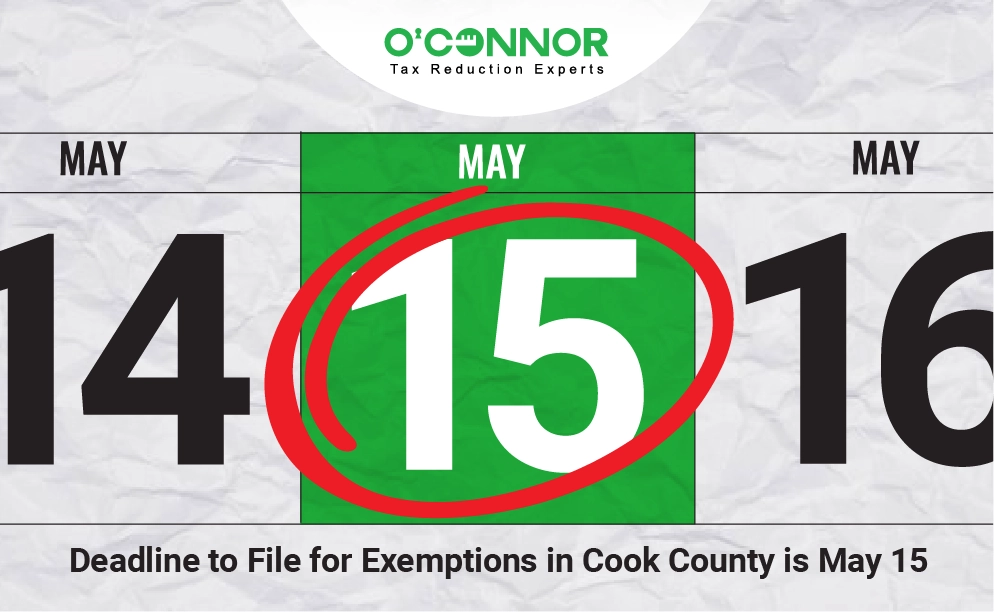
While many are turning to property tax appeals to lower taxes, the easiest first step in getting a reduction is to use exemptions. These can easily shave off thousands of dollars for both homeowners and businesses, and every one of them available for a property should be claimed. While it is easy to get an exemption if you qualify, the deadline to file is quickly approaching. Currently set for May 15, 2026, taxpayers in Cook County have only a few scant days to apply.
How Illinois Exemptions Lower Property Taxes
The homeowner’s exemption and all other property tax exemptions function by lowering the equalized assessed value (EAV). EAV is determined by multiplying a property’s assessed value by the equalization factor. The Cook County Assessor’s Office (CCAO) first estimates the market value of a property by studying sales records for the previous three years. Once this is determined, it is assessed at a certain percentage. Homes are generally assessed at 10% of market value, while most businesses are taxed at 25%. In order to bring things into compliance with statewide requirements, the assessed value is then multiplied by the equalization factor. This results in the EAV, which can then be multiplied by various tax rates to create a bill.
Exemptions are applied to the EAV before tax rates are applied, reducing the EAV significantly. For instance, in Cook County, the homeowner’s exemption will remove $10,000 in EAV from being taxed. To demonstrate, we will look at an example house. The home is worth $800,000, with a tax rate of 2.7%, and an equalization rate of 2.8683. It should be noted that exemptions are only used on the second installment of property tax bills.
$800,000 x 10% = $80,000 (assessed value)
$80,000 x 2.8683 = $229,464 (EAV)
$229,464- $10,000 = $219,464 (reduced by homeowner’s exemption)
$219,464 x 2.7% = $5,925.528 (final tax bill)
The Cook County Exemption Deadline is May 15, 2026
While the second installment of property taxes is a ways away, May is one of the most important months for property owners. First of all, May 15 is the due date for exemptions to be filed in Cook County. This deadline is not just for new exemptions, however, as many types of exemption need to be renewed every year. These exemptions are tied to certain requirements that must be verified every year, typically based on income. This includes the veterans with disabilities exemption and the senior freeze. Even if you still meet all the requirements, you must still file again by the deadline. Usually, a renewal notice is sent out well before the deadline. The homeowner’s, senior, and disabled person’s exemptions do not need to be renewed, and they stay current as long as you remain in your home.
Certificates of Error
If you missed an exemption that you are entitled to, you can file for a certificate of error for the tax years of 2021 to 2024. This can see an exemption being retroactively applied, which can result in a refund being issued to make up for the missed exemption. These refunds have a history of being held up due to issues, and refund delays have been a recurring issue for some taxpayers. Because of these delays, it is easier to simply file your exemption on time. This saves the headache and cost of having to do it later, and stops needless delays.
Exemptions can be Supplemented with Property Tax Appeals
The other reason that May is so important for property owners across Cook County is that it marks the beginning of the property tax appeal season. These protests allow homeowners and businesses the chance to lower their taxes by protesting the values assessed by the CCAO. These appeals do not affect the value that a home or business would sell for, nor do they impact exemptions. Instead, they can lower taxes by getting the CCAO or the Board of Review (BOR) to lower the assessed value on a property. These appeals can be launched due to lack of uniformity or overassessment.
Because appeals and exemptions both lower property taxes in different ways, they work well in tandem. Appeals have the benefit of actually challenging the values set forth by the CCAO, while exemptions lower the EAV after the values have been calculated. By changing the initial numbers to something much fairer, this can produce significant cuts in the overall tax bill. It also ensures that the taxpayer is only paying their fair share by taking care of the root cause. By using the two techniques together, a homeowner or business can get the best savings possible.
Assessor Appeals Opening Up
Taxpayers in Cook County are fortunate enough to get two appeal deadlines, rather than one like the rest of the state. The first window is for assessor appeals, which are directly with the CCAO itself. While the window for these initial appeals is based on the township, the general rule of thumb is that the deadline will be 30 business days after the notices of reassessment are mailed out. Formal BOR appeals will be held later in the year, following a similar pattern based on township. Assessor appeals are a great first step and can often correct errors that lead to higher taxes. However, appeals do require extensive evidence to be successful.
The evidence needed for an appeal to be successful depends on the grounds chosen for the protest. If you are challenging based on lack of uniformity, you must bring in multiple assessments of neighboring properties that share similar characteristics to your own. This includes age, location, classification, size, and the number of rooms. If you are challenging on the grounds of overassessment, you must bring in sales records for similar properties dating back three years. These need to have the same characteristics as those for lack of uniformity.
Property Owners Need to be Prepared for Both Deadlines
Property taxes in Cook County have risen every year for 30 years, and 2026 looks to be more of the same. While you cannot lower your tax rates or equalization factor, you can use exemptions and appeals to control the values that fuel your taxes. Taxes can increase outside of reassessment, such as in 2025, when residential taxes soared an average of 16% across the county. While exemptions are highly recommended for eligible property owners, appeals are quickly joining them as another requirement for financial health.
O’Connor Helps with Analysis and Evidence
If you are looking to supplement your exemptions with appeals, then you will need strong evidence. Gathering so much information before the deadline can be a hassle, but we at O’Connor are here to lend a hand. For over 50 years, we have been helping clients across the nation deal with aggressive values and high taxation. We do this by gathering evidence and analyzing the assessments of our clients, making things easier on you in your pursuit of a reduction. We utilize bleeding-edge databases to find comparable properties, sales records, and assessments, while using data-driven techniques to unearth more evidence. Once everything is together, we coordinate an appeal with Kieta Law, who will act as your representative in filings and hearings. With our evidence, you and your attorney will be on the best footing to win your reduction. You will not pay for this evidence or analysis unless you and your attorney can lower your taxes.