
Riverside has a reputation for having one of the best standards of living in Illinois. Thanks to classic buildings, great schools, and many other amenities, Riverside has found itself as one of the most in-demand townships in Cook County and is one of Chicago’s premier suburbs. This demand has made the township’s property values increase dramatically in the past few years, only enhanced by the infamous 2023 reassessment, which caused values to spike to record levels.
Riverside is now under reassessment again, and values are looking to increase dramatically. As one of the first townships to be assessed, Riverside is also one of the first to get a shot at property tax appeals. With the window for the first round of appeals closing, residents will want to strike fast if they want to secure an early reduction. Otherwise, they will have to wait for the Board of Review (BOR) appeal season in late summer.
The Market Value for Residential Property Surges by $488.88 Million
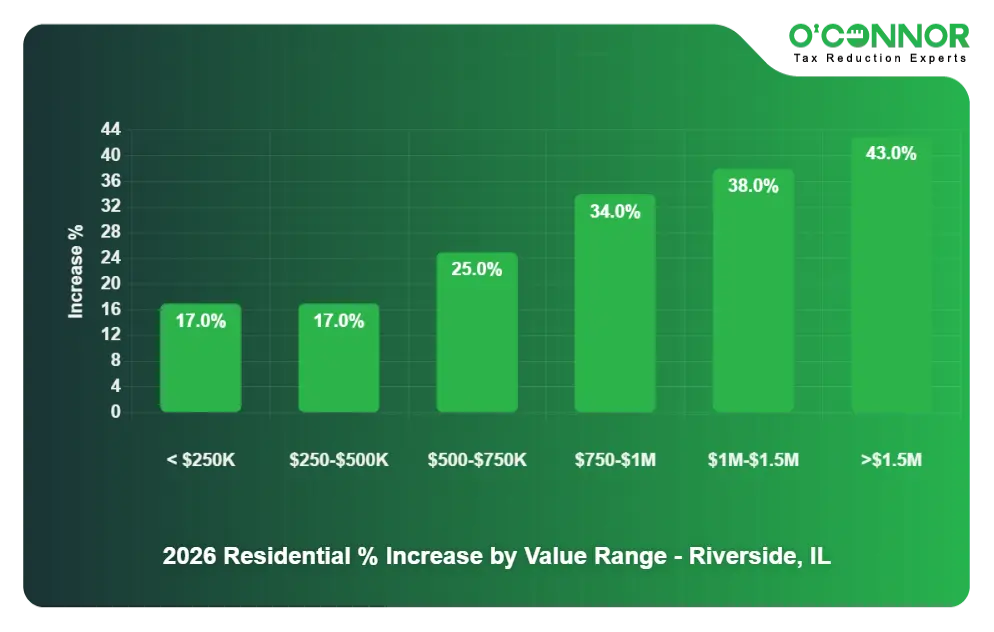
Market value is what the Cook County Assessor’s Office (CCAO) estimates a home will get on the open market. This is determined by studying the last three years of home sales. Once determined, this is then combined with the assessment ratio, the equalization rate, and tax rates to create the equalized assessed value (EAV). EAV is what exemptions are applied to, with the homeowner’s exemption lowering it by $10,000. This makes the initial market value incredibly important, which is why it is alarming that the market value of all homes rose by a combined 23%, or $488.88 million.
Despite a somewhat dated reputation for old money, the largest source of residential value came from homes worth between $250,000 and $500,000, which totaled $1.08 billion following a sharp increase of 17%. Most of these homes would also be of modest size, despite their value. Next were those homes worth between $500,000 and $750,000, which jumped 25% to $795.67 million. Soaring 34%, those worth between $750,000 and $1 million managed to reach a final sum of $341.43 million. Growing by an astounding 38%, homes from $1 million to $1.5 million achieved a final tally of $208 million.
On the opposite ends of the spectrum were the smallest houses and luxury homes. Adding 17% in market value, the smallest homes in Riverside reached $155.44 million. Luxury homes, on the other hand, added 43% and soared to a total of $17.78 million. Considering the value of homes in Cook County, the figures for modest homes were higher than expected, while high-end homes were a little lower than expected. This also goes against the Riverside stereotype.
The 2023 Reassessment Looms Large
Every three years, the CCAO focuses on a different third of the county. In 2023, the southern and western suburbs bore the brunt of the assessments and saw some of the highest increases in property values ever experienced in Cook County. While some homes saw increases of over 700%, the average increases were record-setting as well. For its part, Riverside saw a total increase of 29.38%. The results of the 2023 reassessment caused a massive backlash across both Cook County and Illinois, and have led to more taxpayers than ever looking into property tax appeals in an effort to fight rising values. 2026 has seen more appeals filed already than ever before, showing how much dread the people of Riverside and other townships in the path of reassessment have.
Business Value Spikes by 18%
While it pales in comparison to residential value, commercial property is still important to the community. Increases in property taxes eventually find themselves being passed on to the customer. This can be devastating when it comes to apartments, as rent has already become extremely high in the Chicago area. Smaller businesses can also struggle with sharp increases, and many have been forced to close after a reassessment. In addition, the CCAO will try to focus more on commercial properties to help homeowners escape from rocketing values.
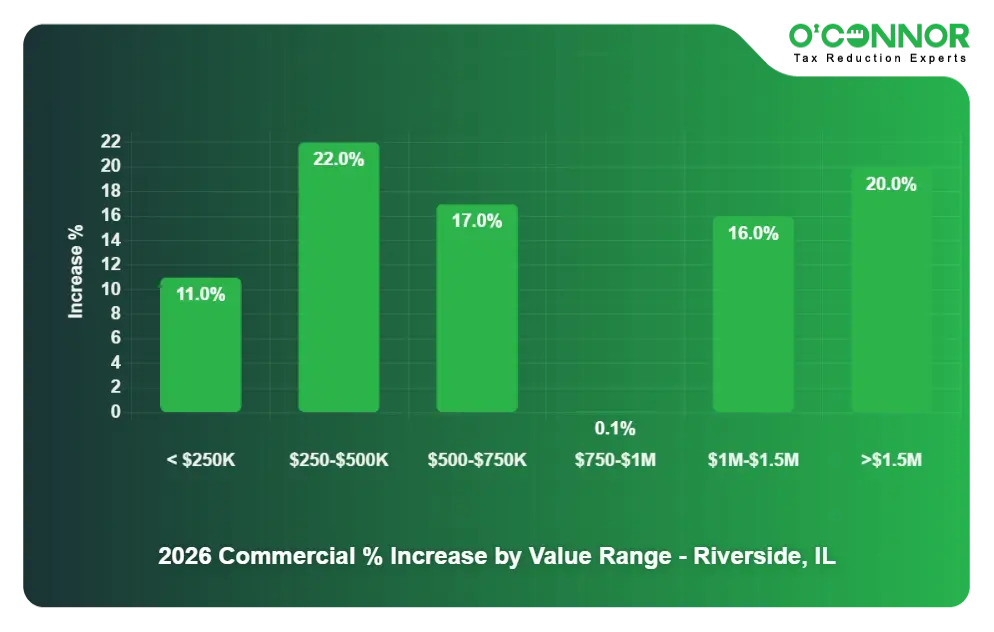
The overall market value for Riverside businesses jumped 18% in 2026, which translated into a new total of $230.18 million. As with most townships, the majority of value was created by large businesses. Those worth over $1.5 million were responsible for $159.77 million of the total, following a jump of 20%. Despite adding 16%, businesses worth between $1 million and $1.5 million totaled only $17.58 million.
The rest of the commercial value was a mixed bag. Those worth between $750,000 and $1 million only saw a tiny uptick of 0.1%, basically unheard of for businesses during a reassessment. Those from $500,000 to $750,000 added 22%, going to $11.84 million. The smallest businesses experienced an increase of 11%, jumping to $15.05 million. While these combine for only a fraction of the overall total, smaller businesses are often the lifeblood of a community, especially a tight-knit one like Riverside.
Riverside Leads the Way with Appeals
While Riverside is one of the earliest townships to get reassessed, second only to River Forest, that also means that it gets one of the first shots at property tax appeals. Appeals allow businesses and homeowners the chance to dispute the values assessed by the CCAO, which can potentially lead to a reduction in taxes. These must be justified, however, with grounds such as overassessment or a lack of uniformity in assessment. However, due to a slew of mistakes and computer errors impacting the CCAO, every property owner is encouraged to protest their values if they are able.
The Deadline for Assessor Appeals is Set for June 8
Appeals come in two stages in Cook County, which means that property owners have two opportunities to secure a reduction, a luxury the rest of Illinois does not have. Assessor appeals are exclusive to Cook County and allow for direct protests to the CCAO. These are held earlier in the year, with the deadline being 30 business days from when the notice of reassessment was published. For Riverside, that will be June 8, 2026, as the notices were posted on April 24. This means that to land a successful appeal, taxpayers must gather evidence and file appeals in a relatively small window. Once this window closes, it will be several months before the BOR opens up for appeals.
The Lifeblood of Appeals is Evidence
With record appeals being filed, even in townships not being reassessed, it will take a lot of evidence to stand out. In order to prove overassessment, a taxpayer must show a collection of property sales dating back up to three years, ensuring that they share the same characteristics of their own property. For lack of uniformity, assessments must be gathered instead, and they should share the same basic characteristics as the protester’s real estate. For the best results, at least five comparable properties should be found, though more is always better. This evidence will need to be curated and organized as well, to make the biggest impact.
O’Connor Brings Expertise to Gathering Evidence
While every taxpayer can handle their own appeal, many in Cook County and Riverside turn to professional firms. This is because it can be a difficult process piecing together the evidence for an appeal. The comparables must not only be exact, but also tell the story you are trying to tell. The CCAO will have its own evidence, so it is best to have more firepower than them. That is where we at O’Connor come in, ensuring that you are not bringing a knife to a gunfight. We have been gathering evidence in appeal cases for over 50 years and are one of the top firms in the county when it comes to finding and analyzing evidence.
We start by analyzing your assessment for any issues, including incorrect factual information. Then, we use data-driven techniques to gather evidence, including using our patented databases, which allow us to find the best comparisons possible. Once we have the best evidence, we will coordinate an appeal with Kieta Law, an expert firm that focuses exclusively on handling property tax issues. Best of all, you will not be charged upfront by us, and you will only have to pay a portion of your tax savings if you and your attorney can lower your taxes.