
The Atlanta area is one of the hottest places to live in America and is seeing even more demand as people flock to the area. While all of the primary counties in the area are seeing meteoric growth, Cobb County is perhaps the most in demand. This influx of people and investment has caused property values to rise by record levels, and property taxes have followed suit. Even though recent legislation was passed to help homeowners, millage rates still continue to increase, and businesses have no such protection. This is why appeals related to property taxes in Cobb County are becoming more prevalent, as they are throughout the rest of Georgia.
Residential Properties Add 4.2% in Market Value
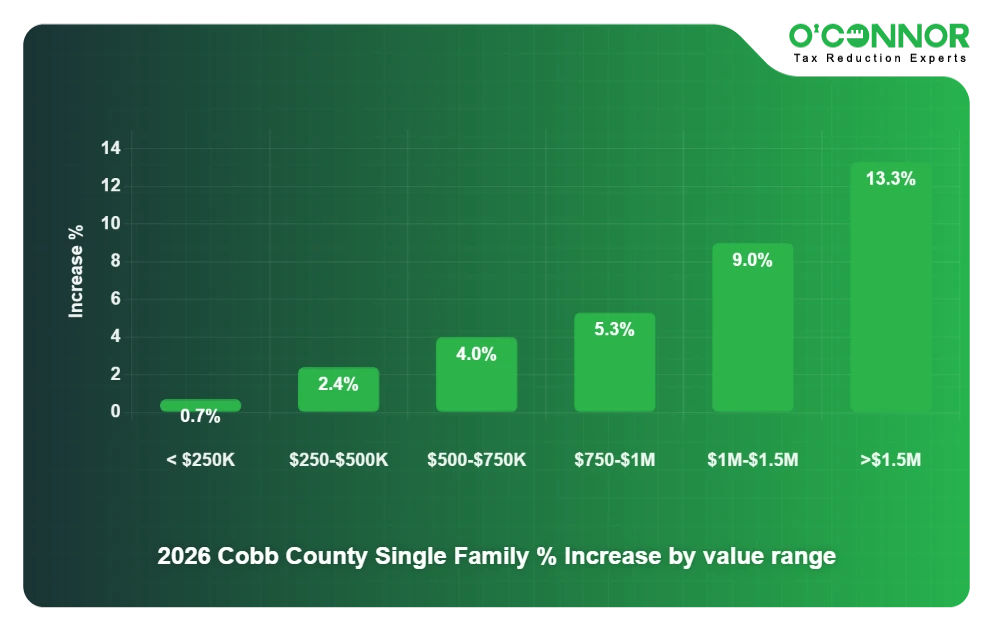
In 2025, homes added around 3.1% to their total market value. In 2026, the Cobb Board of Assessors assessed homes as having grown by 4.2%. This brings the estimated market value for Cobb County to $109.01 billion. The largest source of value was homes worth between $250,000 and $500,000, which grew by 2.4% to total $46.22 billion. This was followed by homes worth between $500,000 and $750,000, which spiked 4% to reach $32.72 billion. Totaling $14.92 billion, residential real estate worth between $750,000 and $1 million was in third place, following an increase of 5.3%. The two most expensive categories of homes added the most value, while those worth under $250,000 only grew by 0.7%, for a tiny overall total of $1.98 billion.
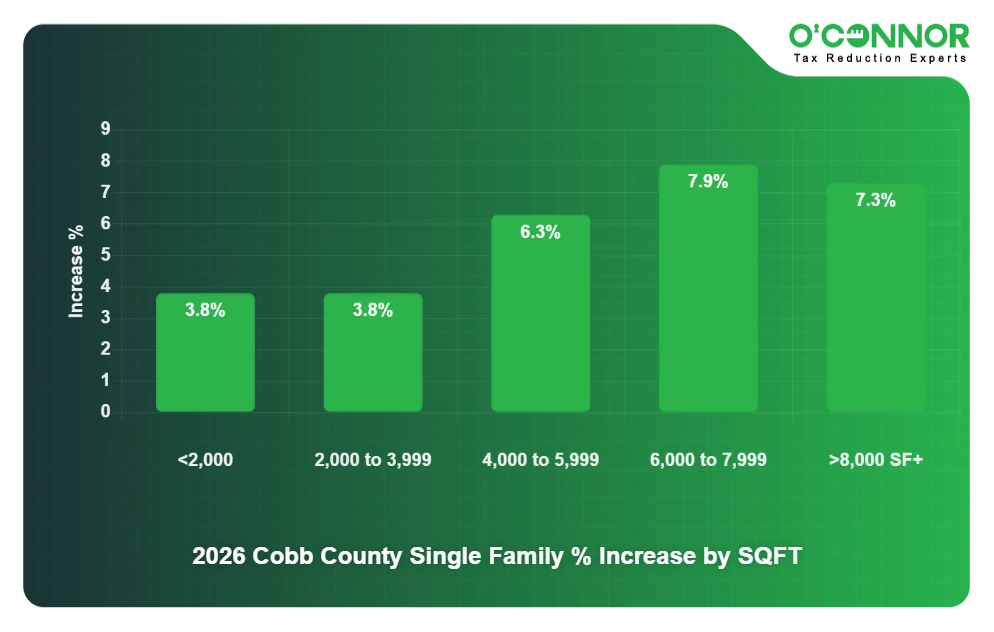
Showcasing the worth of real estate in Cobb County, the high home values mentioned above did not translate into a slew of mansions. Instead, homes under 2,000 square feet account for $35.30 billion of the total following a jump of 3.8%. Homes between 2,000 and 3,999 square feet likewise jumped 3.8%, achieving a final total of $59.64 billion. Larger homes added even more value, with those between 4,000 and 5,999 square feet jumping 6.3% to $11.77 billion. Residences measuring 6,000 square feet to 7,999 square feet added 7.9% to reach $1.71 billion, while truly massive homes added 7.3% to total $590.10 million.
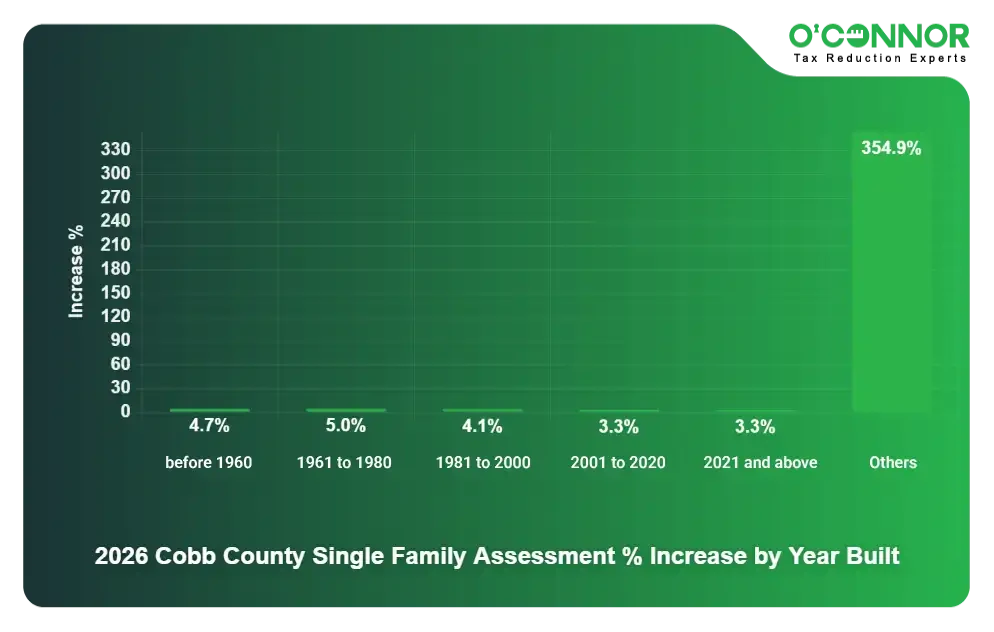
Unlike other up-and-coming counties, Cobb’s homes are mostly older. 43% of all value, roughly $46.91 billion, was built from 1981 to 2000. 29% was constructed between 2001 and 2020. These increased 4.1% and 3.3%, respectively. $20.31 billion was constructed from 1961 to 1980. New construction accounted for just 4%, or $0.55 billion. The value of undeveloped land quadrupled, soaring by 354.9% to total $215.72 million.
40% of Homes Could be Overvalued
Cobb Houses Valued above/below Market Value
The market value of homes in Cobb County is calculated by the Cobb County Board of Tax Assessors by studying sales records going back three years. These numbers do not always keep up with the current market, however, often leading to overassessment or values that are unequal when compared to neighbors. A study of home sales in 2026 indicated that the current assessments may be inaccurate, with up to 40% of all homes being overvalued. In 2025, only 33% of homes were believed to be overvalued. While market fluctuations are common, these changes often open the door to property tax appeals.
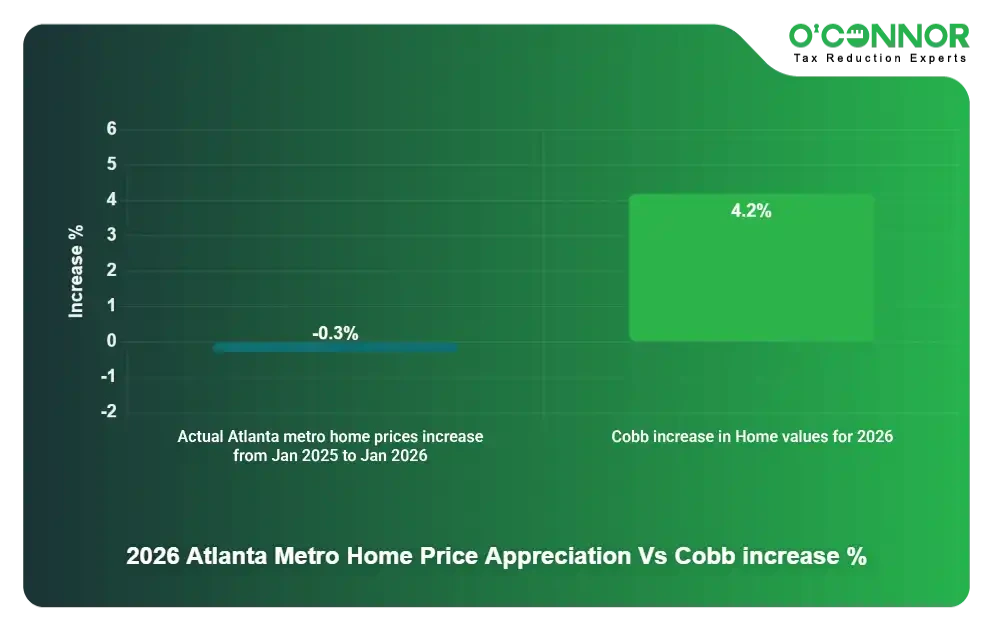
An independent study by Georgia realtors revealed that the value of homes across the Atlanta area had declined by 0.30% between 2025 and 2026. In contrast, the Cobb County Board of Tax Assessors believed the value had increased by 4.20%. While the assessor is focused on Cobb County alone, the overall decrease in 2026 could certainly be a factor in Cobb County. This is another reason that many homeowners should consider property tax appeals.
Cobb County Commercial Real Estate Grows by 6.3%
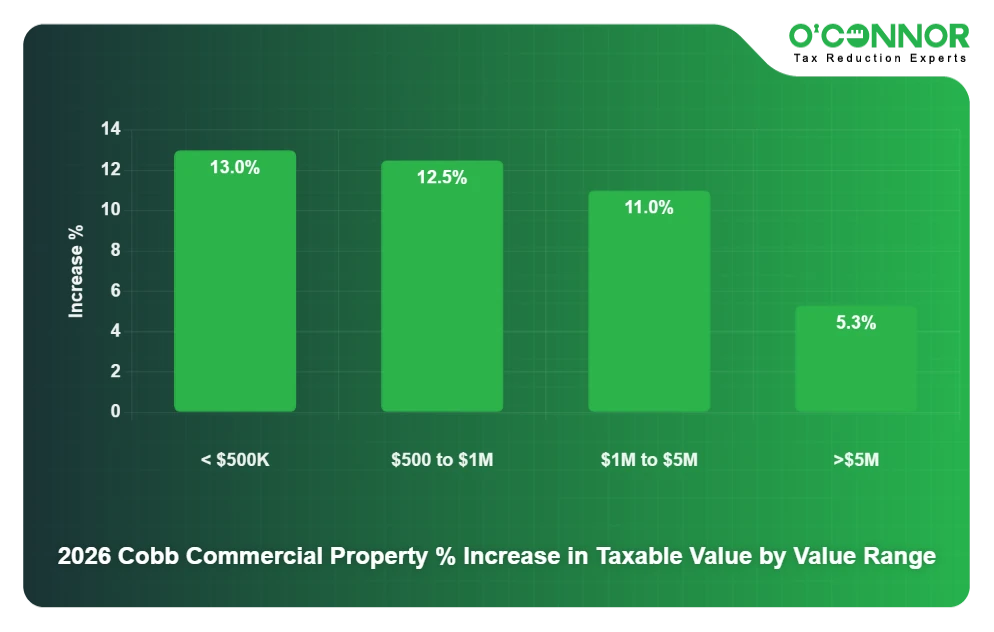
While homes have been the focus of recent legislation, businesses have not seen any significant protections or reductions added. While business is booming across the Atlanta area, property values are surging. Commercial real estate added 6.3% in market value in 2026, achieving a total of $27.45 billion. Jumping 5.3%, businesses worth over $5 million totaled $22.66 billion. Soaring by 11%, properties valued between $1 million and $5 million totaled $3.78 billion. Businesses worth less than $500,000 added 13%, while those worth between $500,000 and $1 million added 12.5%. Despite this large growth, these two categories totaled $346.14 million and $662.70 million, respectively.
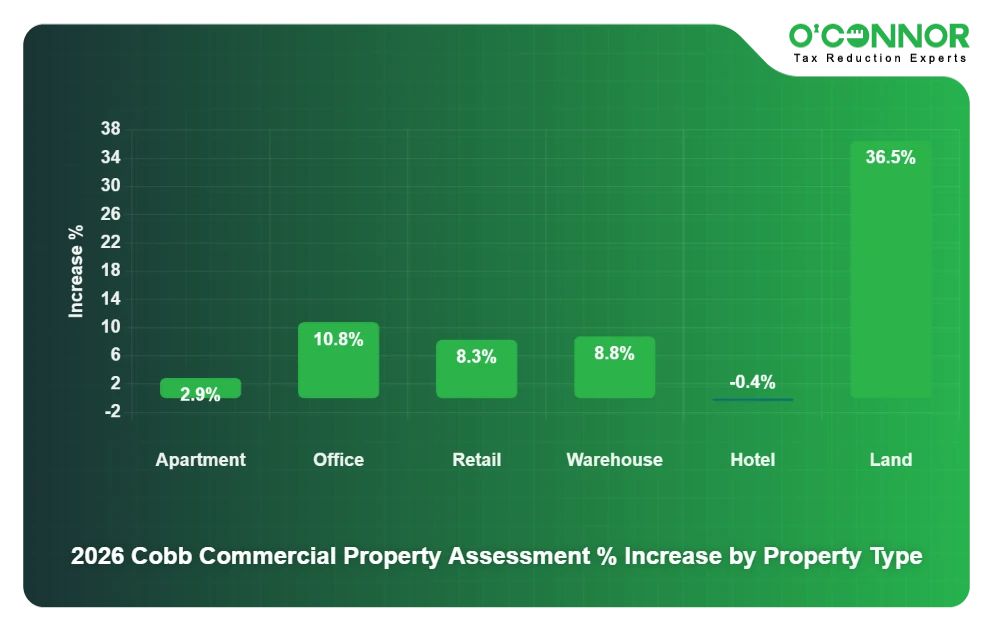
Like most major counties in the nation, the largest commercial property in Cobb was apartments, which totaled $12.49 billion following an increase of 1.9%. Offices surged 10.8% to total $5.43 billion. Retail and warehouses saw surges of 8.3% and 8.8%, respectively, and practically tied with totals around $3.77 billion. Raw land saw a huge jump of 36.5%, while hotels retreated by 0.4%.
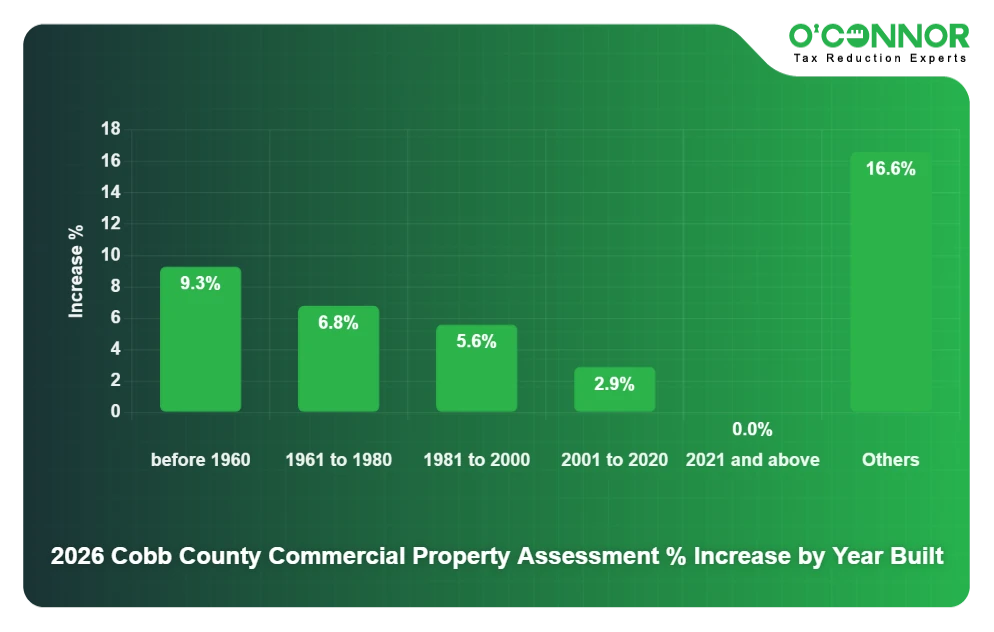
Like homes, commercial real estate saw the largest portion of its value constructed between 1981 and 2000, roughly 45%, or $12.32 billion. Edging up 2.9%, construction from 2001 to 2020 was responsible for $6.70 billion. Those from 1961 to 1980 totaled $5.21 billion after an increase of 6.8%. Raw land spiked 16.6% to $2.95 billion.
Nationwide Commercial Values Drop 15%
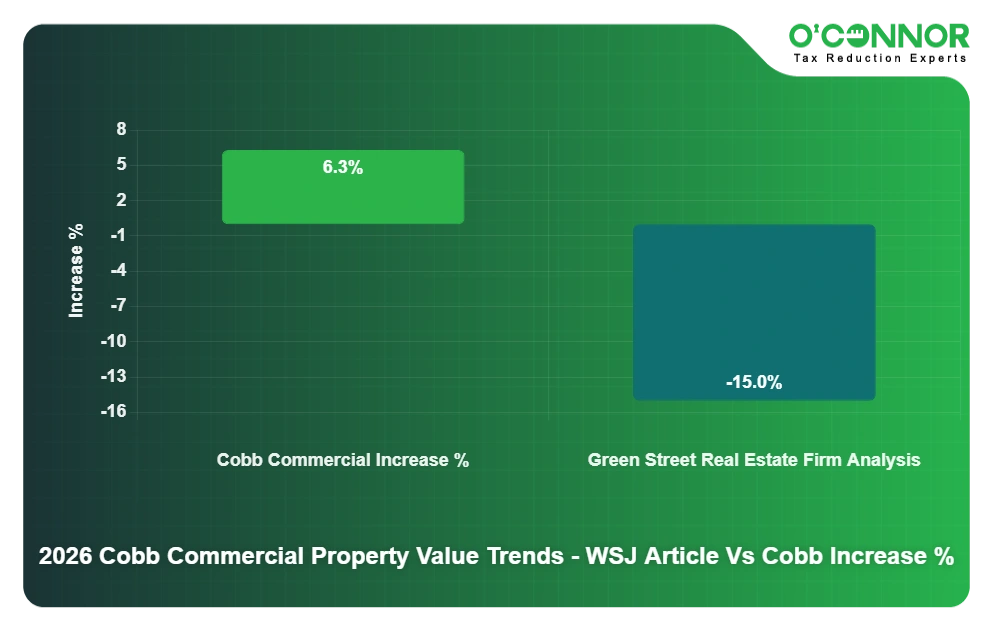
According to a study by Green Street Real Estate, business property across the nation lost 15% of its value since March of 2024. This was mostly thanks to empty office space and changes to how retail functions. This is contrasted by a growth rate of 6.3% for Cobb County businesses. While Cobb is one of the hottest counties in the nation, the discrepancy between the nationwide average and the assessed value could be justification to file an appeal, and should be explored by every business.
Apartments Still King of Value
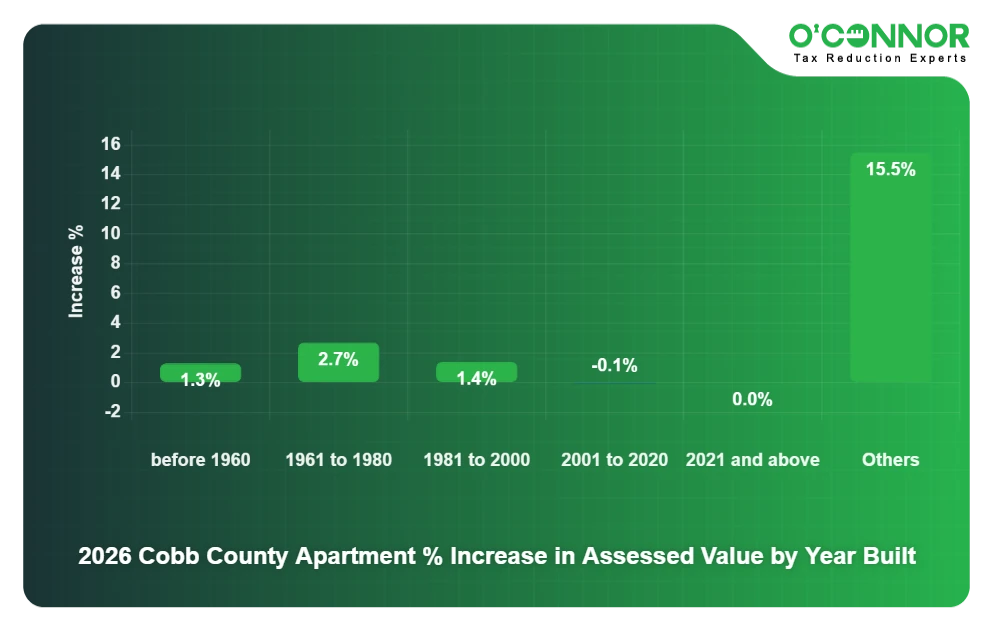
Apartments remain the most valuable commercial property in Cobb County, growing 2.9% to $12.85 billion. Unlike most real estate types, the value is spread relatively evenly across multiple eras of construction. 37% was built between 1981 and 2000, while 26% was built between 1961 and 1980. These increased in value by 1.4% and 2.7%, respectively. 22% of value was constructed between 2001 and 2020, though this saw a tiny value decrease of 0.1%. The oldest apartments were responsible for 2% of the total. Raw land grew 15.5% to total $1.57 billion, representing future construction.
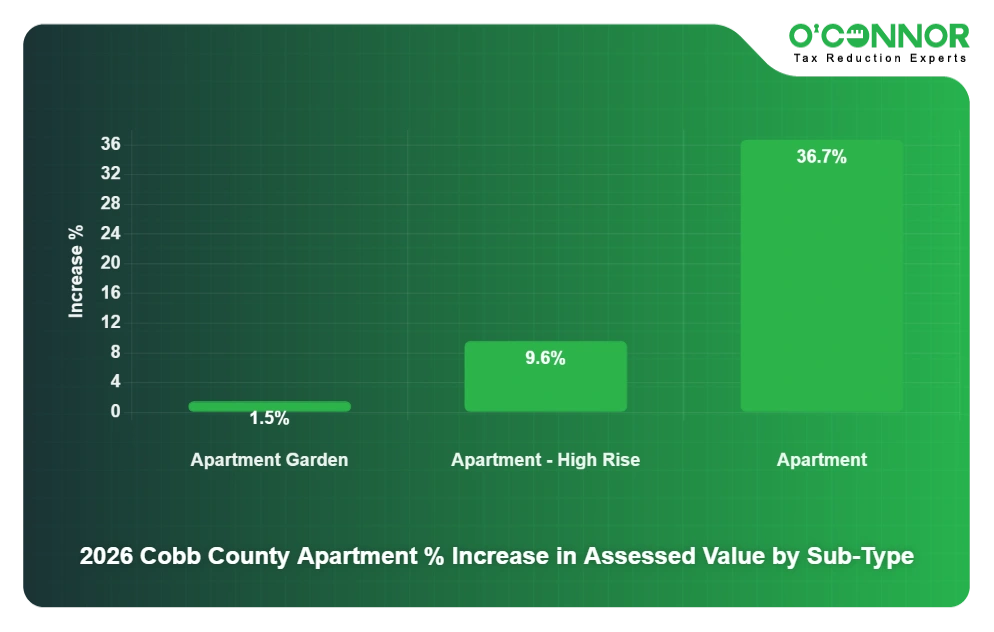
Cobb County apartments were broken down into three categories. The largest was garden apartments, which accounted for $11.87 billion following an increase of 1.5%. Generic apartments soared 36.7% to $533.76 million. High-rise apartments added 9.6% to reach $449.15 million.
Offices Add 10.8% to Market Value
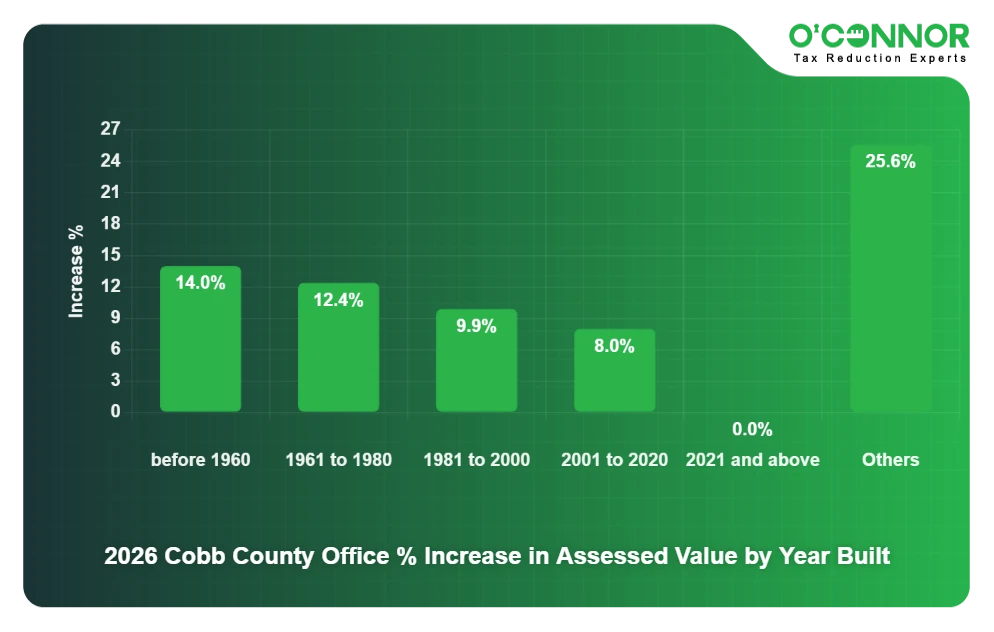
The second-most valuable commercial property in Cobb County, offices continued to grow by 10.8% in 2026, reaching a new total of $5.43 billion. 61% of this came from offices built between 1981 and 2000, which added 9.9% to their market value. 20% came from 2001 to 2020, which spiked 8%. Growing by 12.4%, offices from 1960 to 1981 totaled $539.41 million, roughly 10%. Land set aside for office construction jumped 25.6% to a total of $403.08 million.
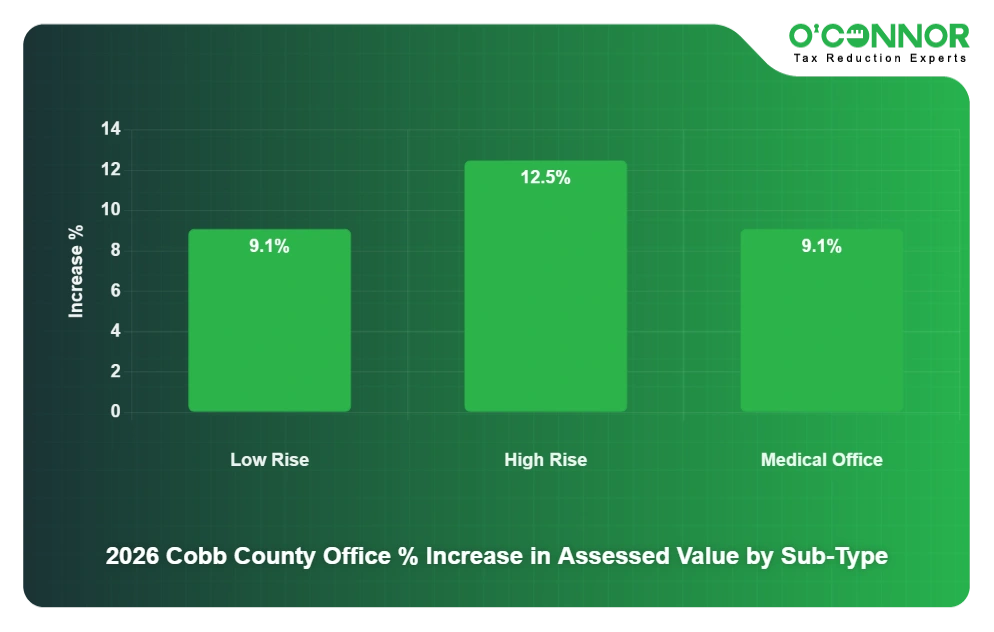
There were three categories of offices in Cobb County. Low-rise offices jumped 9.1% to $1.75 billion, while high-rise offices leapt 12.5% to $2.82 billion. Medical offices added 9.1% to reach $864.61 million.
Retail Sees Strong Growth
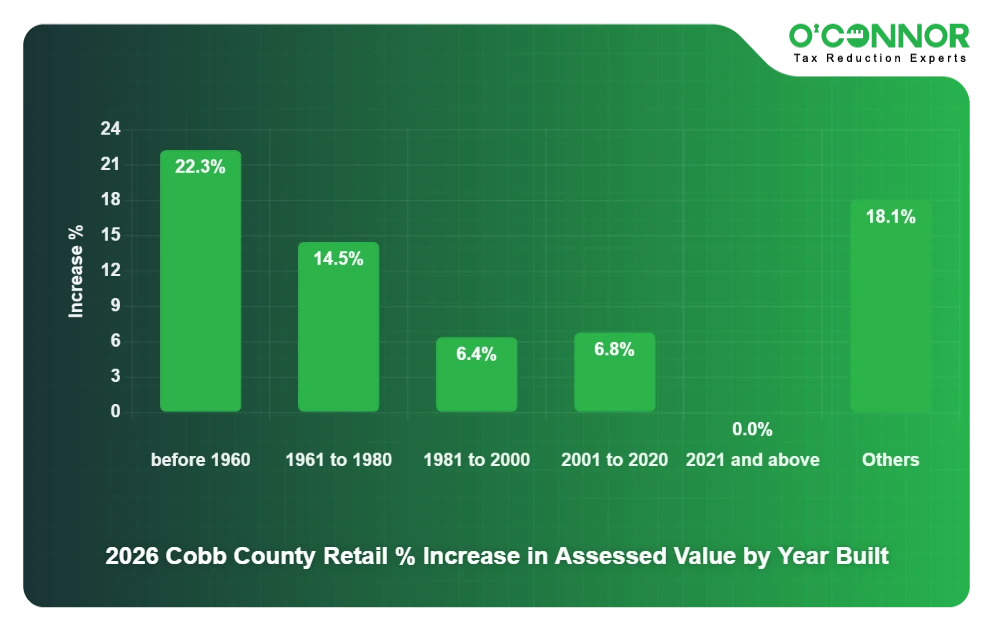
While retail has traditionally struggled in the past decade, Cobb County saw a large increase in value for stores. Retail spaces totaled $3.77 billion in market value after increasing by 8.3%. Like most properties, the majority of this value was built from 1981 to 2000, totaling $1.95 billion following a jump of 6.4%. Stores from 2001 to 2020 added 6.8% to reach $1.04 billion, while those from 1961 to 1980 added 14.5% to total $625.77 million. The oldest stores saw a large increase of 22.3%, but only totaled $103.64 million.
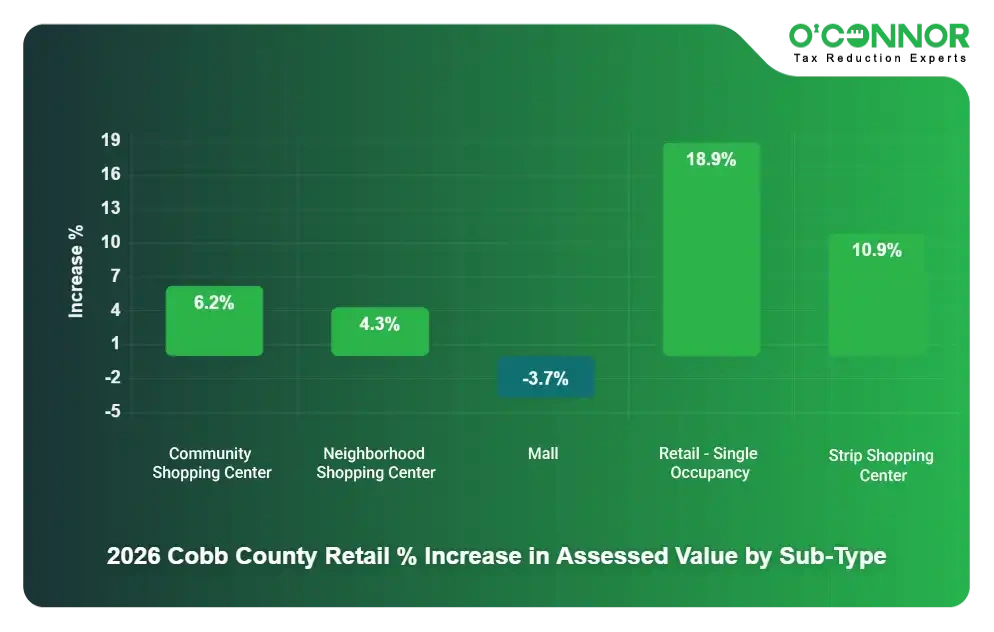
According to the Cobb Board of Assessors, there were five types of retail stores. Single-occupancy stores grew the fastest at 10.9%, totaling $557.07 million. Community shopping centers had a final sum of $901.60 million, while neighborhood shopping centers totaled $878.69 million. These increased 6.2% and 4.3%, respectively. Malls were the only category to see a decrease, dropping 3.7%.
Warehouses See Market Value Jump
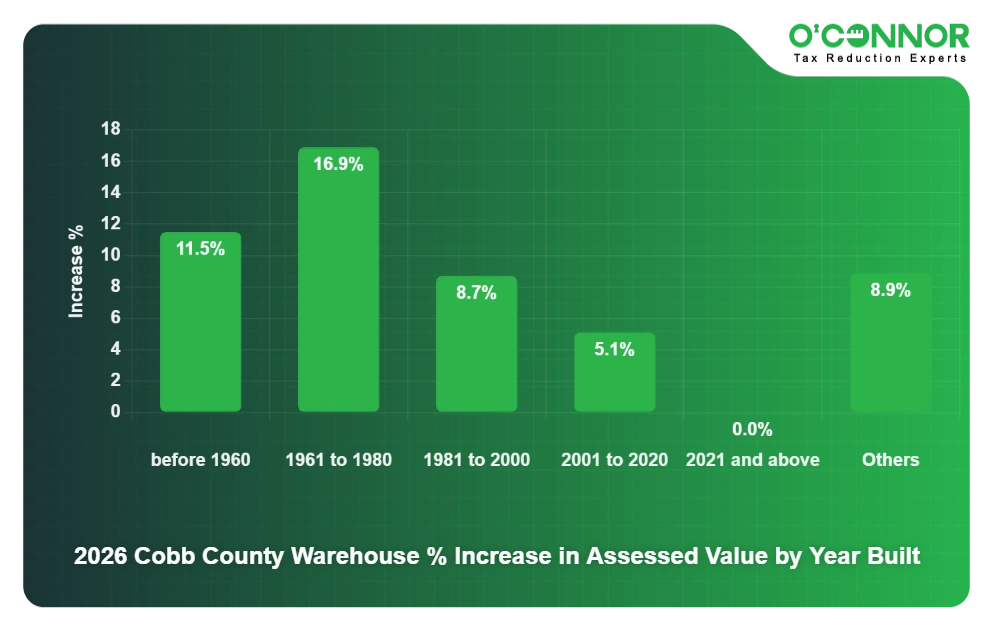
Warehouses experienced an increase of 8.8% and achieved a final sum of $3.77 billion. The largest category of value was those built from 1981 to 2000, which grew 8.7% to $1.57 billion. Those from 2001 to 2020 were in second place with $1.10 billion, following a sharp increase of 5.1%. Warehouses built from 1961 to 1980 surged 16.9% to $548.31 million. 11% of all value came from land set aside for warehouse construction.
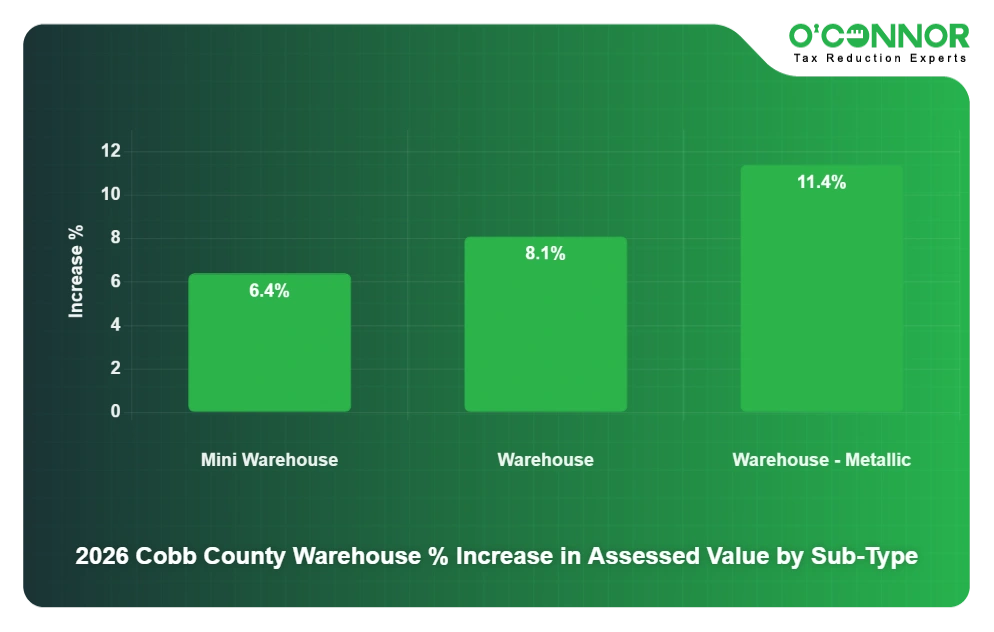
There were three types of warehouses in Cobb County. Generic warehouses jumped 8.1% to total $1.55 billion, while metallic warehouses surged 11.4% to $1.34 billion. Mini warehouses, predictably, were the smallest at $880.43 million, following an increase of 6.4%.
O’Connor Helps Land Reductions and Assessment Freezes
Homeowners got a big boon in 2026, when the House and Senate passed legislation to mandate a statewide homestead exemption and an assessment cap. While the bill was originally meant to cut property taxes down to almost nothing, making previous improvements mandatory will help homestead property owners immensely. However, the owners of second homes or rental properties will see no savings. Likewise, commercial properties will not get an exemption or a cap, leaving them at the mercy of increasing values. Businesses will inevitably be forced to pick up the tab for homeowners.
Homeowners and businesses of all stripes can reduce their tax burden by using property tax appeals. These challenge the values assessed directly, correcting issues that cause higher taxes. This includes cases of overassessment and unequal assessment, which can save homeowners and businesses significantly. The best thing about filing a property tax appeal in Georgia is that a successful protest results in an assessment freeze that lasts three years. This means that if you are able to secure any type of reduction, your assessment will be frozen at that level for the next three years. This can be a major well of savings in a market as fast-paced as the Atlanta area.
O’Connor is here to help you succeed in this quest by providing premium and full-service support. From homeowners to businesses, we put the full force of our firm behind our clients. We gather the evidence needed to win an appeal. First, this is done by using data-driven techniques to study assessments. Then, we use proprietary databases to find the perfect sales and property comparisons. We then weave all of this evidence together and file an appeal on your behalf. We will appear at every hearing, giving you the best shot at a reduction and a freeze. There are no upfront costs to join, and you will only pay a portion of your tax savings if we can lower your taxes. The deadline for most taxpayers to appeal in Cobb County is July 20, 2026, so it is best to enroll as soon as possible.