
River Forest has established itself as one of the top townships in all of Illinois thanks to its charm, great location, and excellent schools. These fantastic amenities have drawn people from not only all around Chicago, but also across Illinois, the nation, and even the world. This has made it one of the most in-demand places to live in Cook County, which has led to rising property values for both homes and businesses. While always a complication for long-term residents and those looking to buy property, these rising costs are magnified by the realities of Illinois and Cook County.
Illinois currently has the highest property taxes in America, and Cook County is leading that dubious charge. To complicate matters further, the 2026 reassessment is hitting the southern and western suburbs hard, which always leads to staggering increases. As the first township to go through reassessment, River Forest is an indicator of things to come.
River Forest Homes Add $724.99 Million in Market Value
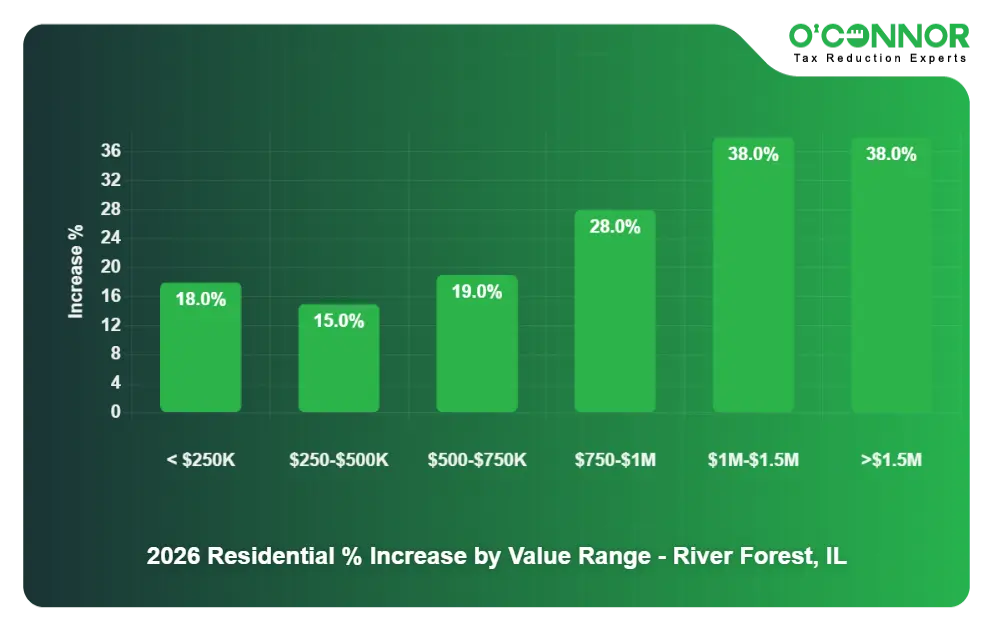
While not the largest township in Cook County, River Forest is still loaded with value. In 2025, the Cook County Assessor’s Office (CCAO) estimated that all homes in the township had a combined value of $2.41 billion. Thanks to reassessment, this total shot up by 30% to $3.13 billion. Homes adding nearly one-third to their value are not uncommon in Cook County during reassessment, but this is on the high side. This also comes on the heels of one of the largest residential property tax increases in history, when 2025 closed by seeing the average residential tax bill jump by 16%.
Affordable housing is a rarity in the Chicago area, and only $138.64 million of the entire total came from homes worth under $250,000, following a surge of 18%. This can often be the most difficult increase to deal with, as it hits working families and seniors hard. Homes worth between $250,000 and $500,000 added 15% to reach $216.07 million, while those between $500,000 and $750,000 spiked 19% to $450.99 million. It should be noted that due to demand, most homes in the township are not luxury homes, and that even modest homes are being valued at high levels.
The majority of residential value was generated by more expensive homes, which also saw higher growth. Those worth between $750,000 and $1 million added 28% to their value, resulting in a final sum of $672.33 million. The largest category was homes worth between $1 million and $1.5 million, which skyrocketed 38% to $1.08 billion. The most expensive homes reached a total of $578.53 million following a jump of 38%. Thanks to decades of increases, more townships across Cook County are seeing similar top-loaded distributions.
Reassessment Shapes Townships
River Forest’s position as the first township to get reassessed has made it a bellwether for decades. It was at the forefront of the infamous 2023 reassessment, which was one of the most impactful in history. In 2023, River Forest added 28.76% in market value, setting the stage for things to come. As the triennial reassessment spun through the rest of the southern and western suburbs, even larger increases were seen, including some homeowners seeing spikes of over 700%. 2023 brought the inequalities of the CCAO’s valuations to light and led to a surge of interest in property tax appeals that has increased every year since.
Businesses Grow by 17%
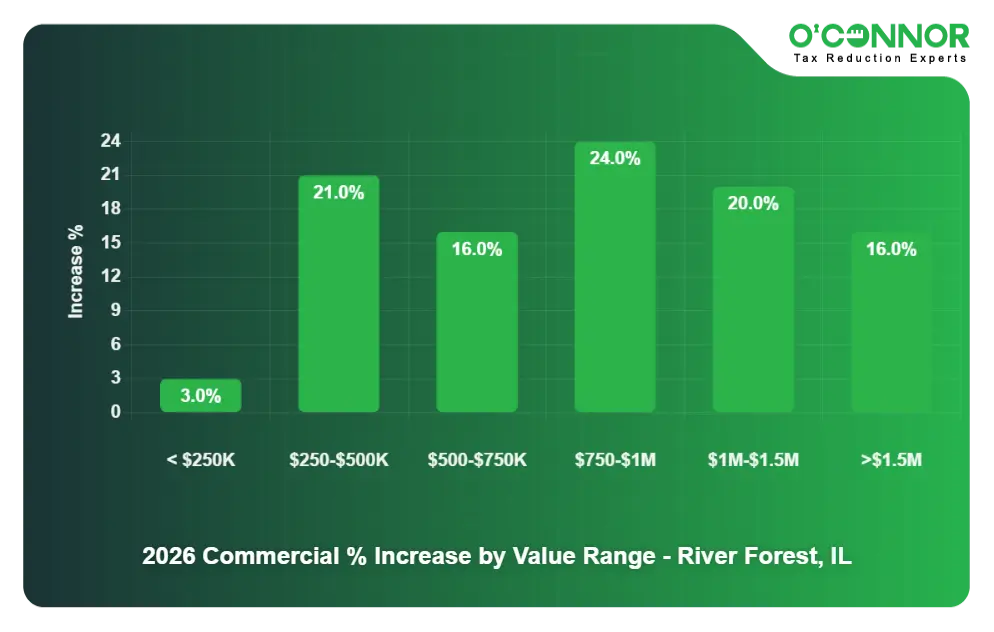
While River Forest is well-known as a residential area, it still has its fair share of businesses, including apartments and retail stores. These grew at a somewhat more sedate 17%, which took the total from $142.89 million in 2025 to $168.53 million. Rises in apartment values often hit the average person the most, but spiking values and taxes for stores can put a strain on the whole community, as they are forced to raise prices. The CCAO has said that it will try to put more of the tax burden on businesses in the near future, even as 2025 showed that the opposite was true.
Like homes, the top-tier business properties were responsible for the most value, though this is typical across the state. Those worth over $1.5 million added 16% to their market value, soaring to $119.48 million. It was thanks to this reserved increase that the overall growth for businesses did not rise more sharply. The majority of commercial properties are worth over $1.5 million, so this reflects the value that most businesses added.
Those worth between $1 million and $1.5 million added 20% to reach the second-highest total of $13.28 million, while those worth between $750,000 and $1 million jumped 24% to $7.69 million. Businesses with an estimated worth of $500,000 to $750,000 grew 16% to $10.01 million. Commercial real estate worth $250,000 to $500,000 accounted for $9.89 million following a large increase of 21%. Only the smallest businesses saw an increase in the single digits, with an uptick of 3%.
Appeal Season Begins with River Forest
Property tax appeals challenge the assessments put forward by the CCAO and can lower market values significantly with the right grounds and evidence. This means that the equalized assessed value (EAV) is often lower as well. EAV is the base value for tax bills, so scoring a reduction can be paramount. Even if a reduction is not possible, knowing the true worth of a home or business can grant owners peace of mind, as they know they are not being assessed unfairly. Appeals are often filed every year, as this can establish the correct value of a home or business, which can then be used to bolster future appeals. This is invaluable in an environment that sees constant increases in values and taxes. It should be noted that appeals do not lower the resale value of a home or business, and only lower taxable values.
The Deadline for Assessor Appeals in River Forest is June 2, 2026
River Forest is not only the first township to go through reassessment, but also the first to enter the window for appeals. In Cook County, there are two appeal deadlines, unlike the rest of Illinois, which is stuck with only one. Things open with assessor appeals, which are made directly to the CCAO. The deadline to file these is 30 business days after the notice of reassessment was published, which is June 2, 2026, for River Forest. After the assessor appeal deadline passes, appeals with the Board of Review (BOR) will take place months later. By protesting now, taxpayers can land a solid reduction.
Successful Appeals Require Evidence
Unlike exemptions, appeals require evidence to lower taxable values. They must have evidence to prove that a reduction is needed. This is done by proving overassessment or a lack of uniformity in assessment. Overassessment is when the market value of a property is higher than its actual market price. This is proven by collecting multiple sales records, dating back three years, for properties that match the location and characteristics of your home or business. Lack of uniformity occurs when your property is assessed more than properties with the same size, age, and location, and can be shown by collecting multiple assessments. For the best results, a minimum of five sales records or assessments should be collected, though the more there are, the better the result.
O’Connor Secures Key Evidence and Utilizes Analytics
Gathering evidence for your appeal is both time-consuming and vital to your cause. Every comparison needs to be done right to paint the perfect picture of your property. No matter if you are going for overassessment or lack of uniformity, you will need to do a ton of digging. We at O’Connor are here to help in that regard and have been doing so for over 50 years. Initially based in Houston, we have spread to property tax hotspots across the nation, including Cook and the surrounding collar counties. We even have a branch office in Aurora specifically to help the people of Chicagoland.
We gather evidence by using data-driven techniques and careful analysis of your assessment. We then use our patented databases, which find ironclad comparisons that demonstrate the true value of your home or business. Once these are compiled and properly analyzed, we will coordinate an appeal with Kieta Law, a firm dedicated to property tax reduction. With our evidence on your side, you and your attorney will be in the best position to win a cut. You will not pay anything for this evidence unless you and your attorney can reduce your taxes.